


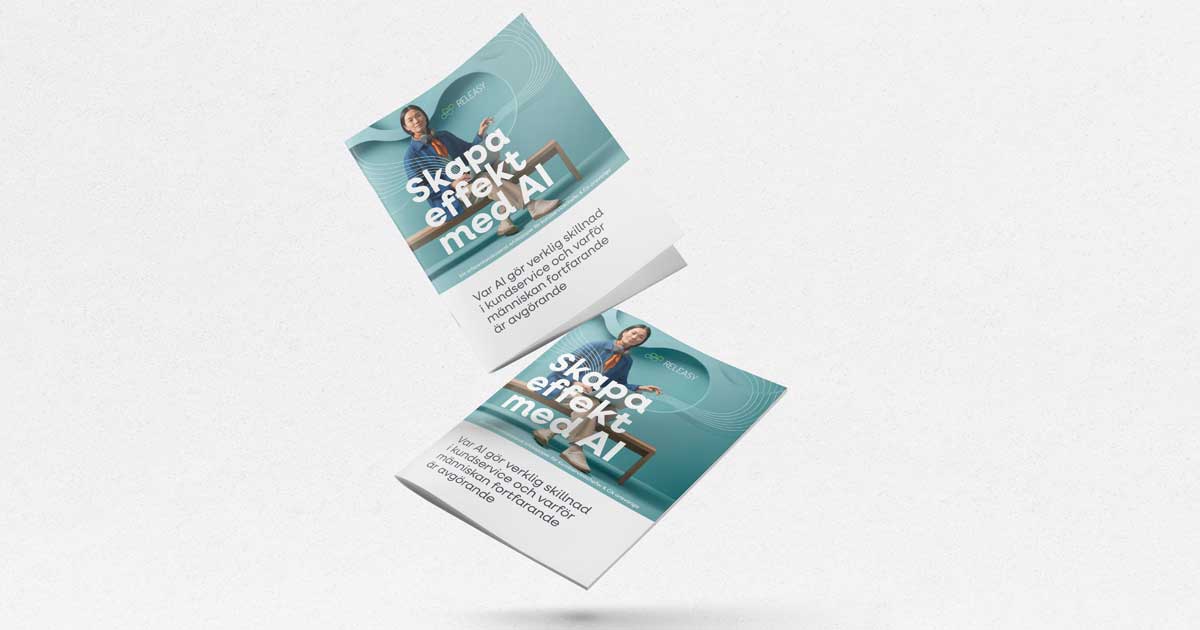
Creating Real Impact with AI in Customer Service
Where does AI create real impact in customer service, and when is the human touch still essential? Releasy’s new whitepaper brings together insights from real customer service interactions, tangible results, and lessons on how organisations can move forward even when integrations, security requirements, or limited IT capacity set the boundaries.
AI can already handle a great deal in customer service. Yet it is rarely the technology’s capabilities that determine whether an AI initiative delivers real impact. The key question is what the solution is allowed to do within the existing environment, what information it can access, and how the results can be measured.
This is the starting point for Releasy’s new whitepaper, “Creating impact with AI.” Rather than presenting an ideal scenario, it draws on experience from real customer service operations and shows how AI can be used to reduce workload, support employees, and generate deeper insights.
Choose the right problem from the start
The best starting points are often cases with high volumes, clear rules, and recurring patterns. Bookings, delivery status, invoice enquiries, and other information-based requests can sometimes be fully automated. In other cases, AI creates the most value by preparing information, categorising cases, performing checks, or routing enquiries to the right place.
Keeping people where they make the biggest difference
Despite the positive impact AI can create, we are committed to not automating every customer interaction. Conversations that require empathy, experience-based judgement, or the ability to turn a difficult situation around still depend on human expertise.
The ambition is therefore not to have AI do as much as possible, but to use the technology where it creates value and frees up people’s time for the interactions where judgement, relationships, and problem-solving are essential.
“For us, AI isn’t about automating as much as possible. It’s about using AI where it creates real value for the customer, the employee, and the business.”
Johan Frodell, CEO of Releasy
The whitepaper also explores how organisations can start working with AI within their existing security frameworks. Read-only access, for example, may be enough to summarise case histories and prepare information, while existing interfaces can be used while waiting for a full integration. In some cases, it is possible to move forward even without connecting systems.
In one of Releasy’s customer assignments, the solution was built using information available outside the customer’s environment and, despite these limitations, was able to resolve 40–50% of the cases in that particular flow.
What organisations that achieve real impact have in common is not that they use AI for everything. They prioritise the right areas, monitor performance, and continuously improve the solution.
In the whitepaper, Releasy shares more examples, its AI principles, and practical questions to help customer service and CX leaders identify the right place to start.